Posts

A personal story about dealing with wood smoke

  After 14 years of fighting air pollution locally generated by neighbours from their wood stoves, fire pits, fireplaces, and open burning, we have sold and moved away from our community on Gabriola Island, British Columbia.   It was the most difficult decision of our lives, and a seemingly impossible one. Choosing between your health and home isn’t fair.   After writing dozens of letters to various levels of government on this issue, presenting to councils, setting up a pollution monitoring network using PurpleAir technology, presenting academic work at conferences, being interviewed more than 50 times by media on the topic, working with a group of wonderful, like-minded people to create a non-profit called the Gabriola Island Clean Air Society, and joining the Board of an international group called Doctors and Scientists Against Wood Smoke Pollution, I am exhausted.   We lost many friends over this battle, incurred significant financial costs, were taunted and shun...

Health impacts of air pollution in Canada, 2021 report

Summary A large body of scientific evidence has accumulated over the past 25 years attributing a wide range of adverse health effects to ambient (outdoor) air pollution exposure. These effects range in severity from respiratory symptoms to the development of disease and premature death. Significant advances in the health and atmospheric sciences over the last two decades have also made it possible to estimate the number of deaths and illnesses associated with air pollution. In Canada and internationally, health impact assessments identify air pollution as one of the largest risk factors for premature death and disability. In this report, air pollution is defined as pollutants that scientific studies have associated with wide-ranging health effects and to which the population is ubiquitously exposed in the outdoor environment. These pollutants include fine particulate matter (PM 2.5 ), ground-level ozone, and nitrogen dioxide (NO 2 ). This is an update to previous health impacts of air ...

Learn more about woodsmoke and alternatives to burning wood

Here's an interview with Dr. Michael Mehta on local radio in Nelson, B.C., on woodsmoke from an environmental and human health perspective. His part starts at approximately 30 minutes in.

Your fireplace and wood stove are major drivers of deforestation

Image
If you burn wood to heat your home, you may not realize how many trees are consumed every year by this choice. It's often difficult to see this since most of us have wood delivered in trucks loaded with smaller and sometimes split pieces. On Gabriola Island, our consumption of wood is the equivalent of 545 logging trucks/year of trees, and this consumes 55 Ha (136 acres) of mature forest every year. Much of this wood is imported from woodlots on Vancouver Island. If parked end-to-end, these 545 trucks (21.5m in length) would be 11.75 km long - almost the length of the island. Here's the math and the hyperlinked references to support these calculations. Forests in B.C. are relatively productive compared to other parts of the world.  A Ha of mature forest yields on average 400 cubic meters of wood.   Not all of this wood can be used as firewood but we'll use this number since data on actual amounts of usable wood are difficult to come by. A lower number of usable quantities...

The burning question: How to tackle air pollution and health threats from wood stoves?

Gabriola Island Clean Air Society board member, Dr. Michael Mehta, is quoted in this article in the National Observer on wood stoves. He states: "If the stereotype associated with country living holds fast, folks in Canada’s small towns and rural communities should be relishing the benefits of fresh, clean air. But rather the opposite is true, said Michael Mehta, a professor of geography and environmental studies at Thompson Rivers University in Kamloops, B.C. The full article is here .

Outdoor Wood Boilers (OWB) Are More Than A Nuisance

Image
From time-to-time, the Gabriola Island Clean Air Society receives emails from across Canada from people who are desperate for help. Their local and provincial governments have failed them. Recently, an individual from Cold Lake, Alberta, reached out to us. He and his family live in a residential neighbourhood where people commonly use wood stoves, burn bon fires, and even use outdoor wood boilers (OWB) for heating. Here's a photo of his neighbour's OWB in operation. Properties in this community are on one acre lots - so this is close to his house. According to the individual who connected with us: "The volume of smoke from this OWB, is dozens of times greater than a traditional in-home wood stove. And, the OWB never shuts off. When it is not in active ‘plume mode,’ it smoulders and produces a constant stream of acrid, creosote-smelling smoke, 24 hours a day, 7 days a week. He has wood delivered at the start of each winter, by a logging ...

PurpleAir sensor readings are virtually indistinguishable from government monitors according to new peer reviewed study

In August of 2016, the Gabriola Island Clear Air Society brought online the first PurpleAir sensor network in Canada. Our sensor network has documented extensively the staggering amount of air pollution coming from wood stoves and fireplaces on our tiny island. As the number of PurpleAir sensors expanded across the province and elsewhere in Canada, many began to raise questions about the accuracy of these low-cost devices. There have been several studies to-date that all show the same thing: these devices work, are accurate, reliable, and fill in gaps in air quality monitoring. The newest study from Australia by Dr. Dorothy Robinson provides definitive evidence that should quash any concerns about using PurpleAir sensors. See the study here .  Gabriola Island Clean Air Society director Dr. Michael Mehta has the following to say about this study. This paper provides empirical evidence to show that the use of low-cost PM2.5 monitors for measuring air quality on a distributed basis ha...

The not so hidden consequences of burning wood

Image
As we see neighbour after neighbour receive deliveries of wood for next winter, and some down on the beach with chainsaws cutting logs washed ashore, this image really hits hard.

The PurpleAir network on Gabriola Island detects the beginning of wildfire season

Image
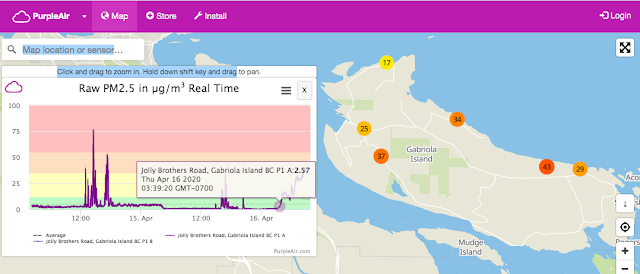
Last night a state of emergency was declared in the Squamish area due to a new wildfire in the region.  By late Wednesday night it had reached 60 Ha in size. See the following article in the The Squamish Chief. The smoke from this fire was detected by one of our PurpleAir sensors at 3:39AM (some four hours later) on Gabriola Island (approximately 80km away as the crow flies). All of our sensors on the island detected this smoke soon after. The levels of smoke are in the 30-40 micrograms/m3 range currently (as of 9:16AM) on Gabriola Island. Although still lower than what people are often exposed to due to wood stoves and fireplaces on the island, PM2.5 at even these concentrations can be challenging for those with breathing difficulties, and those with confirmed or suspected COVID-19 may experience a worsening of symptoms. Here's another graph that shows you how to tell the difference between wood stove smoke and wildfire smoke based on these sensors. Because of how wo...

Using the average is dangerous and irresponsible when it comes to air pollution exposures from wood stoves

Image
When it comes to air pollution, there seems to be special "rules" for how it is measured that doesn't reflect true risk or scientific evidence. Averaging exposures over longer periods of time ignores hundreds of scientific and medical studies on the significant and often irreversible impacts associated with short-term, acute exposures to high levels of air pollution. Yet, regulators and others usually ignore these effects and exposures. This approach involves using 24-hour and annual averaging which works somewhat when you believe that the airshed is a uniform and homogenous thing. This model is designed for urban areas where industrial pollution is more common, but in rural communities this approach understates the risks from wood burning for home heating and other purposes. Wood burning creates hyperlocal air pollution and the nature of this combustion process leads to rapid increases in PM2.5 pollution. PM2.5 sized particles are the most dangerous air pollutant, ...

The use of wood stoves and fireplaces should be banned

Gabriola Island Clean Air Society director, Dr. Michael Mehta, discussed on Global News BC yesterday the need for a provincial ban on wood stoves and fireplaces to reduce the risks associated with COVID-19. Mehta thinks the current fire bans are a good first step, but believes officials should go even further to control smoke by banning the use of fire places and wood stoves. Mehta acknowledges such a move could be politically unpopular but said it would help protect the older populations living in the rural communities. To read the article click here .

Dramatic reductions in air pollution are needed to keep us healthy

Dr. Michael Brauer from UBC wrote the following piece in the Globe and Mail about air pollution and COVID-19. Certainly, there has been reduced vehicular traffic and economic activity due to physical distancing. But that doesn’t mean all drivers of pollution have been eliminated. In British Columbia, other major sources include open burning of agricultural and forestry waste, as well as residential wood heating and road dust. The wildfire season is also quickly approaching, bringing with it the potential for severe smoke. And in the past week alone, elevated levels of health-damaging particle air pollution have been measured on Vancouver Island and in Metro Vancouver with authorities poised to issue air-quality advisories. In our interior communities, spring has already brought about multiple air-quality advisories, prompted by the dust that’s unleashed when the snow melts and winter traction materials dry up. Dr. Brauer goes onto note that roughly 800,000 people in B.C. live with ...

Wood burning is a cultural malady and a "pandemic" in slow motion

Image
The hyper-local nature of wood smoke pollution may make small communities like Gabriola Island BC hotspots for COVID-19. With COVID-19 spreading rapidly around the world, and awareness of how air pollution may increase the risk of contracting the virus and exacerbate lung conditions for those with the infection , it's clear that wood burning on Gabriola Island and nearby is a cultural malady. Nothing here has changed. Although there is now a ban on outdoor burning, wood stove use is rampant and it is perhaps worse given how many people are working from home, off school, etc. According to  Daniel Bings , with the Ministry of Environment and Climate Change Strategy. There is strong evidence that exposure to air pollution increases susceptibility to respiratory viral infections by decreasing immune function. In other words, poor air quality may increase the number of COVID-19 cases and make these cases more severe. In large cities like LA where air pollution is also a major...

With wildfire season just around the corner, does it make sense to have fuel on your property?

Image
There are so many contradictions and blindspots associated with burning wood for residential home heating. People stack large amounts of presumably dry and seasoned wood on their property, and often right beside their homes. If a wildfire started in a place like Gabriola Island, this could be the perfect storm for disaster. Here's an interesting example of a firewood seller who delivers to the island. He'll remove brush and debris while dropping off more fuel (wood).

Risk from air pollution exposure and justice: Citizen science monitoring provides the tools needed to better understand these issues

Image
Take a look at the following. It shows how "Air pollution can vary by as much as eight times within the span of a single city block. The air quality data produced by the nearest monitoring station didn’t reflect what Historic West End residents [Charlotte, North Carolina] were actually breathing." See the story here . 

Pellet stoves are big polluters too

Image
In case you harbour the belief that pellet stoves are clean and green. This pattern of high air pollution in Kamloops at a location on the north shore is driven by a neighbour with a newer pellet stove.

"Pollution could be damaging your brain"

GICAS director Dr. Michael Mehta's research is mentioned in the Globe and Mail in an article on air pollution and brain development. “While research and regulations tend to focus on vehicular emissions, Dr. Mehta noted that the largest source of air pollution in many rural Canadian communities is biomass burning. In Gabriola Island, B.C., where he lives part of the year and where many heat their homes with wood stoves and fireplaces, Dr. Mehta said he was surprised to find air-pollution measurements that were significantly worse than in the country’s urban centres.”

DIY solar furnace event

Image

Gabriola Island currently has the worst air quality in North America

Image
Thank in large part to people who burn yard waste, and still operate their wood stoves in late April, Gabriola Island currently has the worst air quality in North America. The 232 micrograms/m3 reading on the map is our island. This level of PM2.5 is almost ten times the provincial maximum based on a 24 hours average.

Do N95 masks work to protect you and your family from wildfire smoke?

Image
Dr. Michael Mehta of TRU wearing a Vogmask . Yes, I've heard the jokes about Darth Vader and Silence of the Lambs. Over the past two years people in many parts of British Columbia have been exposed to unusually high levels of particulate pollution from wildfires. The messaging from the BC Centre for Disease Control (BCCDC), and public health officials from Interior Health and other publicly funded health care providers, has been mixed and noticeably negative about the benefits of wearing N95 respirator masks as a risk reduction measure. In a recent article by Ashley Legassic of CFJC Today, she quoted Interior Health Medical Health Officer Dr. Kamran Golmohammadi as follows:  "They require fitting," he says. "In other words, it  has to be tight on the face. So people with facial  hair, small children and people who cannot fit  (the mask) properly... will not benefit from these  masks and there are alternative ways and more  e...